Posts

Showing posts with the label images

Final Day Assessments
Image
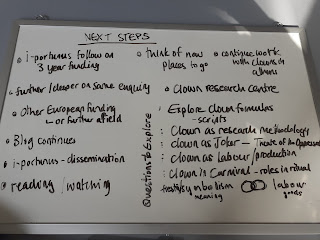
On our last day together in Athens, the three of us revisited the project and reflected on: - 2 days collaborating with others - the whole project and the lessons we can draw - what we want to do next Group cohesion and complicity  Compared to the first day, the second day with collaborators brought a higher level of cohesion and group complicity. This probably arose from having a group organization, with tasks assigned from the beginning of Day 2, as opposed to Day 1 when each individual could set their own tasks. Particularly on the return to the workspace, there was much more group work than on the journey from the workspace to the designated place of action on Day 2. However, valorising this is not an easy task. Some collaborators, in the feedback, valued the individual freedom of Day 1 over the group cohesion of Day 2. The feedback of others was the opposite. In general, this valorisation was related to the fun that the person reported having. This raises another question: how...
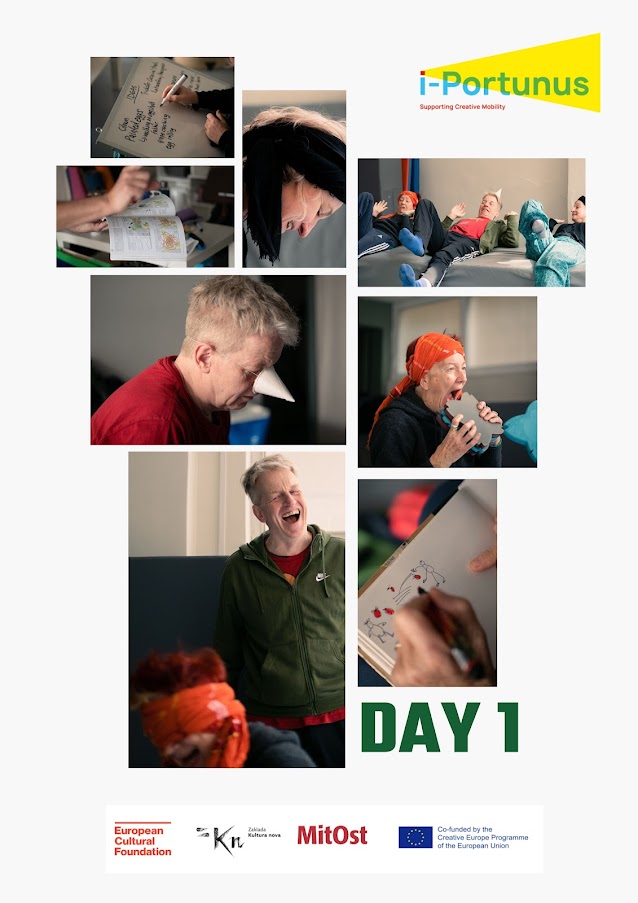
Day 1 in photos

Image
 

Costume Exploration

Image
 One area we wanted to explore was costume, and we decided to work with simple, cheap materials that could be shared between us and our collaborators. We began by using paper, card, sack, string and other related bits and pieces. Some of these we brought with us, some we shopped for in the many small shops in central Athens near to our two working spaces in Exarcheia and Monastiraki.  These materials seemed like they might work to make quick costumes inspired by some of the carnival and other traditions we are interested in. During the first five days we created several costume pieces and imagined several more, including shirts, trousers, skirts, collars, hats, shoes, noses, etc. See below for some images. Jon Davison Materials: Costume pieces:

Preparing for the Research Residency - Old European Traditions of Clown-Tricksters

Image
One of our sources was the many traditions across Europe that use mask, costume, story, event, character and symbol in communal celebrations and festivities. These include carnival, seasonal changes, saints' days and more. For the three researchers, these traditions are sometimes familiar, sometimes not, sometimes embedded in our cultures in forgotten places. We also are able to see parallels on other continents, but prefer not to speculate as outsiders beyond this acknowledgement.  Many of these traditions involve some kind of clown-like figure, often in the mode of trickster and frequently in the role of devils. As clowns, these are the most interesting to us. We wanted to make these kinds of clowns one of our starting points, rather than the kind of clown we had mostly been formally trained in, which comes from the very recent lineage of theatre clown training in studios, from Lecoq, through Gaulier, with many contemporary clown teachers reproducing the assumptions of what clown...