Posts

Showing posts with the label street

Final Day Assessments
Image
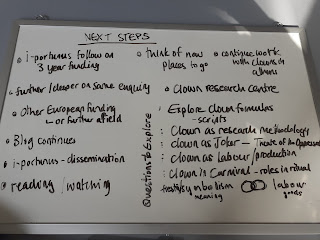
On our last day together in Athens, the three of us revisited the project and reflected on: - 2 days collaborating with others - the whole project and the lessons we can draw - what we want to do next Group cohesion and complicity  Compared to the first day, the second day with collaborators brought a higher level of cohesion and group complicity. This probably arose from having a group organization, with tasks assigned from the beginning of Day 2, as opposed to Day 1 when each individual could set their own tasks. Particularly on the return to the workspace, there was much more group work than on the journey from the workspace to the designated place of action on Day 2. However, valorising this is not an easy task. Some collaborators, in the feedback, valued the individual freedom of Day 1 over the group cohesion of Day 2. The feedback of others was the opposite. In general, this valorisation was related to the fun that the person reported having. This raises another question: how...
Working with Collaborators - Second Day

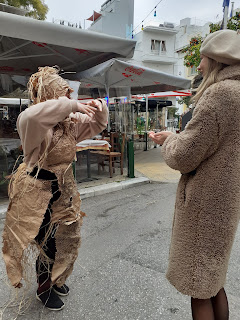
The three of us spent the morning assessing the previous day's activity and coming up with a new plan for the afternoon.  We decided to plan a simple scenario with clear differentiation between roles, that we would invite collaborators to make real, first by making costumes appropriate for each role, and then by going to a specific nearby square to carry out the scenario.  IN order to simplify this transition from idea via costume to street action, we decided that the three of us would assume key organising roles, to avoid collaborators having to concern themselves with direction, and also to ensure we stayed on track.  The roles were: - central figure / silent clown (Jon) - high priestess (Hilary) - ritual organiser (Robyn) - 2 free clowns - several ritual enactors The free clowns had the task of engaging verbally and gesturally with any onlookers, encouraging them to ask questions such as: What are they doing? What is this? What does it mean? The aim was not to provide ...

Working with Collaborators - First Day

Image
  Public workshop 1   Six participants with a variety of performance skills and experiences attended the workshop.   Introduction We briefly explained our project, how we were funded and the themes and ideas we had explored in the 5 preceding days: ·        our clown lineages, and how these were very euro-centric and similar to each other ·        our desires to interrupt normative patterns of behaviour in public spaces ·        experiments in inviting passers-by, the general public to participate in our creations - egg games and (sort of) meaningless non-competitive competitions ·        our desires to create work that provokes through entertainment, addressing political and social justice issues   Performance preparation We then invited participants to go out onto the streets with us in a short, improvised performance aroun...

Brecht's Epic Theatre

Image
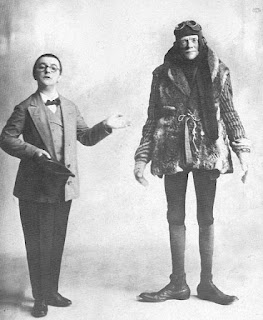
Some extracts from 'The Street Scene - A Basic Model for an Epic Theatre' by Bertolt Brecht, translated by John Willet, with annotations and commentary relating to our project. the point is that the demonstrator acts the behaviour of driver or victim or both in such a way that the bystanders are able to form an opinion about the accident. Finding ourselves in such a tourist city as Athens, we wanted to avoid presenting people with something they simply consume and take pictures of and say 'oh that was nice' The demonstrator need not be an artist. The capacities he needs to achieve his aim are in effect universal. We worked quickly, with whichever collaborators turned up. The intention was more important than any supposed technique. This is in opposition to most clown training in Europe today, so influenced by Lecoq and Gaulier.  Suppose he cannot carry out some particular movement as quickly as the victim he is imitating; all he need do is to explain that he moves three...